

“We want to become more strategic.” It’s a phrase we hear constantly from leaders and teams across industries. Yet, for all the ambition behind it, the reality of delivering on that promise is often far murkier. In my experience working at AtheosTech with global and international clients, I’ve seen a recurring pattern: IT consulting, despite its promise, frequently fails ambitious leaders.
The challenge isn’t a lack of expertise or technical skill. The problem lies in how IT strategy consulting is applied. Organizations hire consultants to provide clarity, foresight, and guidance, but most firms get trapped in tactical work, leaving strategic potential untapped. Whether it’s product discovery, innovation strategy, or designing product-to-product integrations, the failure often stems from a misalignment between ambition and execution.
The Strategy Trap: Templates Over Transformation
Many leaders believe IT strategy and consulting services will instantly elevate their organization’s strategic capability. In practice, too often, these services are offered as pre-packaged solutions, frameworks, slides, and workshops that sound impressive but fail to address the unique realities of the organization.
Take an international financial services firm I worked with in London. They engaged a top-tier consulting firm, expecting comprehensive strategy execution support. Weeks later, the firm had stacks of documents and workshops, yet the internal teams were unclear on how to implement any of it. They were stuck hitting the proverbial “project wall,” completing one-off deliverables without advancing long-term strategic priorities.
This is the essence of the illusion: it looks like strategy, but it isn’t anchored in the systems, processes, and people who execute it.
Why Execution Falls Short
Even the most brilliant IT strategy services fail if they aren’t paired with actionable execution. Here’s why:
- Plan vs. Reality – Many organizations craft ambitious plans but rarely adapt to changing customer needs or market disruptions. Without agility, long-term goals become outdated before execution begins.
- Siloed and Unclear Interdependencies – Strategic intent is often lost as it cascades through the organization. Teams work in isolation, advancing their own priorities rather than the shared objectives.
- Lack of Accountability – Without ownership and transparent reporting, even the clearest strategies stall. Team members may not feel responsible for outcomes, leading to drift and underperformance.
- Static Processes – Traditional performance reviews emphasize past results rather than insights for future success. This leaves organizations slow to respond and unable to seize emerging opportunities.
When these factors combine, IT strategy consulting services risk being seen as a cost center rather than a strategic accelerator.
Mission Leadership: Bridging the Gap Between Strategy and Execution
We’ve developed frameworks inspired by what we call Mission Leadership, designed to close the gap between strategic intent and tangible results.
Mission Command: Decentralized Execution
Leaders define intent while empowering teams to make frontline decisions. This approach:
- Encourages initiative and agility, enabling teams to solve problems faster.
- Closes the execution gap by allowing quick reaction to change.
- Builds trust and accountability, ensuring teams own outcomes.
Mission Clarity: Clear, Resonant Goals
Strategy becomes actionable when broken into emotionally resonant “missions.” Every team member knows:
- What success looks like.
- Why achieving it matters.
- How their role contributes.
This clarity ensures everyone moves in the same direction, reducing wasted effort and conflicting priorities.
Leadership and Followership: Emotional Commitment
Strategy execution is more than compliance; it’s a belief. Leaders inspire commitment by:
- Storytelling to reinforce purpose.
- Recognizing contributions to deepen engagement.
- Fostering ownership at all levels.
Battle Rhythm: Continuous Review and Adaptation
Strategy must be dynamic. Regular “battle rhythm moments,” like Mission Status Reviews, allow organizations to:
- Focus on forward-looking insights.
- Rapidly adapt to internal and external changes.
- Maintain alignment across distributed teams.
Winning Behaviors: Culture Meets Strategy
Mission Leadership defines the behaviors necessary for success:
- Clear communication.
- Unconditional mission delivery mindset.
- Trusting teammates to deliver.
- Operating within established boundaries.
High-performance culture emerges when behaviors align with strategy, eliminating ambiguity and ensuring execution matches intent.
Lessons from Global Leaders
Consider the CEO of a London-based professional services firm we partnered with. Every month, she met with her extended management team to communicate strategy and priorities. Employee engagement surveys suggested alignment; 84% of staff reported understanding the company’s top priorities.
However, when we surveyed the team on the details, fewer than one-third could correctly identify even two of the five strategic priorities. This disconnect illustrates a common pattern: leaders think they’re communicating effectively, but shared understanding is rarely achieved.
Across 500+ companies, only 56% of distributed leaders could name one of the company’s top priorities. Lower-level employees fared even worse, highlighting the execution gap that IT strategy and consulting services must bridge.
Building Shared Context: Four Actionable Steps
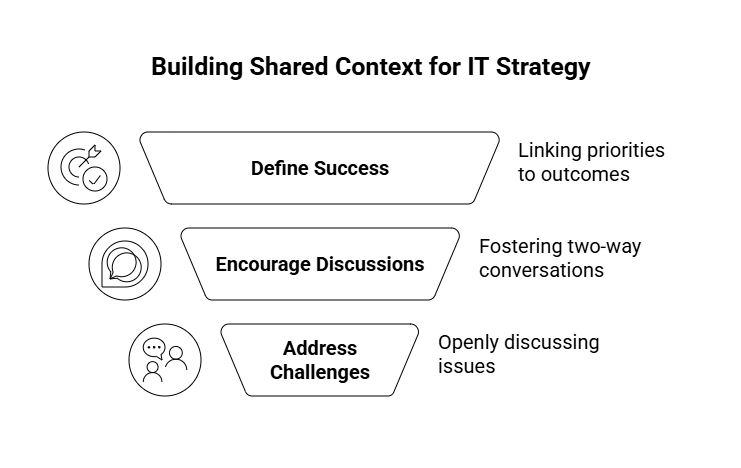
- Simplify Communication – Strategy should be expressed in simple, repeatable language. Every announcement should reinforce the must-win battles (MWBs).
- Define Success Clearly – Link priorities to tangible outcomes. Knowing the finish line helps teams make better daily trade-offs.
- Encourage Discussions, Not Lectures – Frequent two-way conversations build shared understanding. Listening is just as important as telling.
- Talk About What’s Not Working – Openly discuss challenges and update progress regularly. Transparent scoreboard metrics reinforce alignment.
These steps create a foundation for meaningful IT strategy consulting that translates into results.
Reframing the Consulting Model
Firms seeking to move beyond tactical work must rethink strategy delivery. We advise:
- Re-architect Strategy and Execution Around a Shared Proposition – Strategy and execution should serve a single, coherent client journey.
- Require Prospects to Start With Strategy – Discovery or innovation strategy must be the entry point, even before execution begins.
- Design the Full Client Journey Around This Shift – Align go-to-market strategy, delivery rhythm, and team structures with this proposition-led approach.
By integrating product discovery, innovation strategy, and product-to-product solutions into a holistic framework, organizations move from illusion to tangible impact.
Conclusion
IT strategy consulting doesn’t fail because it lacks knowledge; it fails when strategy is disconnected from execution. Ambitious leaders must demand clarity, alignment, and accountability. They need consulting that is part of their journey, not just a temporary advisor.
AtheosTech partners with leaders to transform IT strategy and consulting services into actionable, measurable outcomes. We help organizations move beyond the illusion, embedding strategy into daily operations and creating long-term, high-impact results. When done right, strategy isn’t a PowerPoint; it’s an engine driving success, innovation, and sustained growth.


Leave a Reply